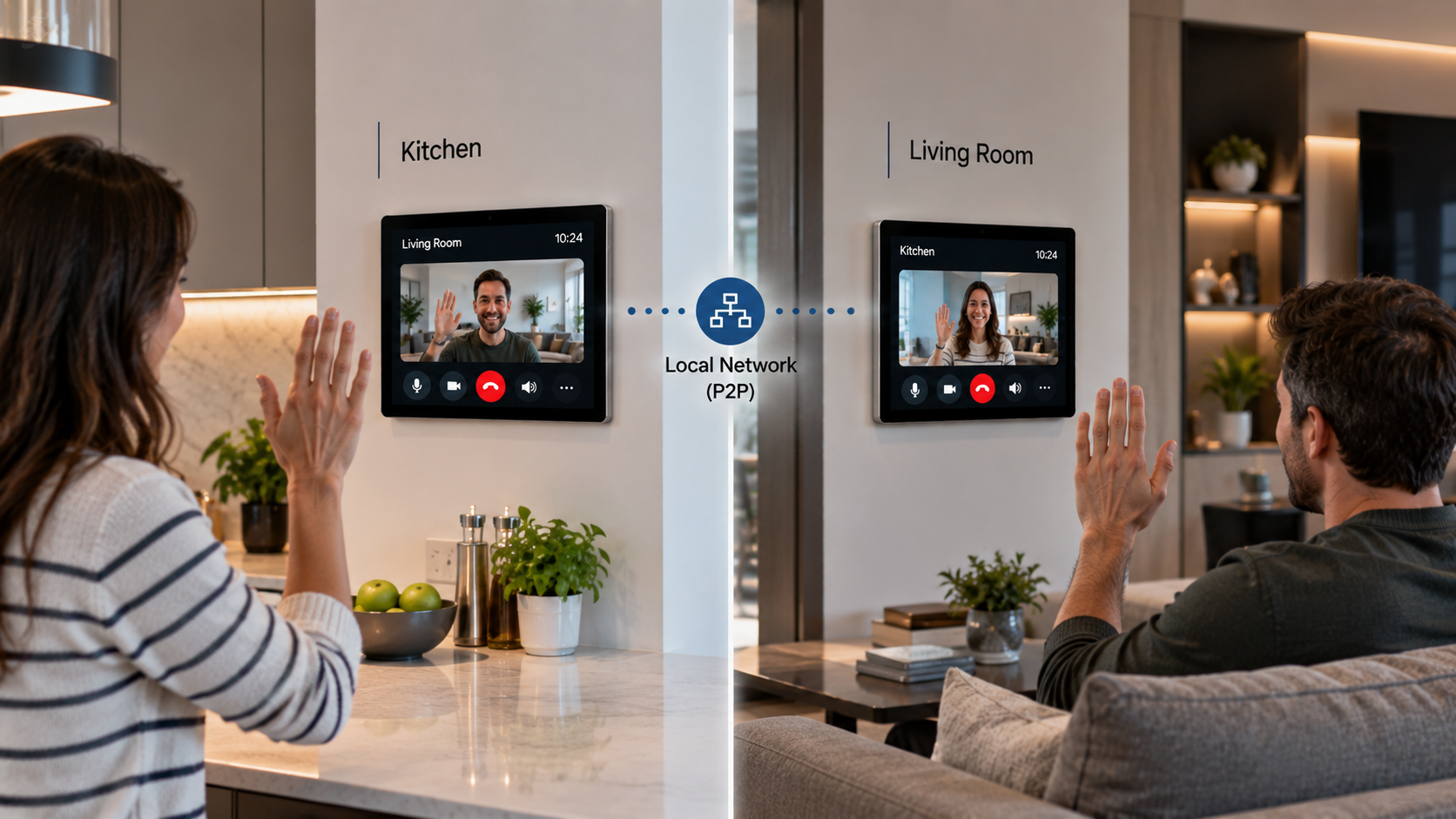
The Intercom API in App Container supports two communication models: SIP through a PBX and direct peer-to-peer (P2P) communication between AVS touch panels.
This gives integrators the flexibility to use an existing SIP infrastructure when a project requires it — or build a local intercom system without deploying a PBX at all.
SIP with a PBX
For projects that already use SIP infrastructure, an AVS touch panel can register with a SIP PBX and operate as a SIP endpoint.
This makes it possible to integrate the panel with:
- SIP extensions
- Compatible SIP door stations
- Other SIP endpoints
- Existing intercom infrastructure
- Building communication systems
A typical installation could look like:
Door Station → SIP PBX → AVS-10
When an incoming call reaches the panel, App Container exposes the call state to the HTML5 interface through the JavaScript Bridge.
The interface can then display a custom incoming-call screen with caller information and controls such as Answer, Reject, and other actions defined by the integrator.
For a door-entry application, SIP communication can also be combined with other automation functions. The same interface could present the video call alongside an Unlock Door control connected to the project's access-control system.
P2P — No PBX Required
For communication between AVS touch panels, a SIP PBX is not always necessary.
App Container supports direct peer-to-peer communication over the local network.
For example:
AVS-10 Kitchen ↔ AVS-10 Living Room
or:
AVS-10 Reception ↔ AVS-15 Conference Room
The panels communicate directly using their local network addresses.
This makes P2P especially useful for smaller installations where deploying and maintaining a dedicated PBX would add unnecessary infrastructure.
A residential installation, for example, could have AVS panels in several rooms:
Kitchen ↔ Living Room ↔ Bedroom ↔ Office
Users can call another room directly from the control interface while the same panel continues to provide lighting, climate, audio, security, and AV controls.
Automatic Panel Discovery
App Container can discover compatible AVS panels available on the local network.
The HTML5 application can use this information to build a dynamic intercom directory.
Instead of manually hard-coding every room into the interface, a project could display discovered panels such as:
Kitchen
Living Room
Primary Bedroom
Office
The interface can also react when panels become available or disappear from the network using events such as:
panelFound
panelLost
This allows developers to build a room-to-room communication interface that reflects the actual state of the installation.
Direct Calling from HTML5
Once a panel is known, the HTML5 application can initiate the call through the App Container JavaScript Bridge.
For example:
await window.appcontainer.sip.placeCallToIp('192.168.1.50');With a PBX configuration, the same application can call an extension:
await window.appcontainer.sip.placeCallToExtension('101');From the user's perspective, both can be presented through the same interface.
They don't need to know whether the call is traveling directly to another panel or through a PBX.
P2P Paging
Peer-to-peer communication also enables another useful capability: paging multiple AVS panels across the local network.
Instead of calling one room, an interface can initiate a page to available panels:
await window.appcontainer.sip.pageAll();This opens use cases such as:
Whole-home paging
“Dinner is ready.”
Office announcements
“Meeting starting in Conference Room A.”
Retail and hospitality
Staff announcements across multiple areas.
Security
Local announcements distributed through installed AVS panels.
The important difference is that this communication can remain inside the local network and does not require a cloud communication service.
One API, Two Architectures
The result is a flexible communication architecture:
P2P
AVS Panel ↔ AVS Panel
No PBX required.
SIP PBX
Door Station / SIP Device → PBX → AVS Panel
Designed for integration with larger SIP environments.
Both approaches are controlled from the HTML5 application through the same App Container Intercom API.
This allows an integrator to choose the architecture that fits the project instead of designing the user interface around the communication infrastructure.
The user simply sees one consistent interface for AV control, automation, intercom, and paging.